
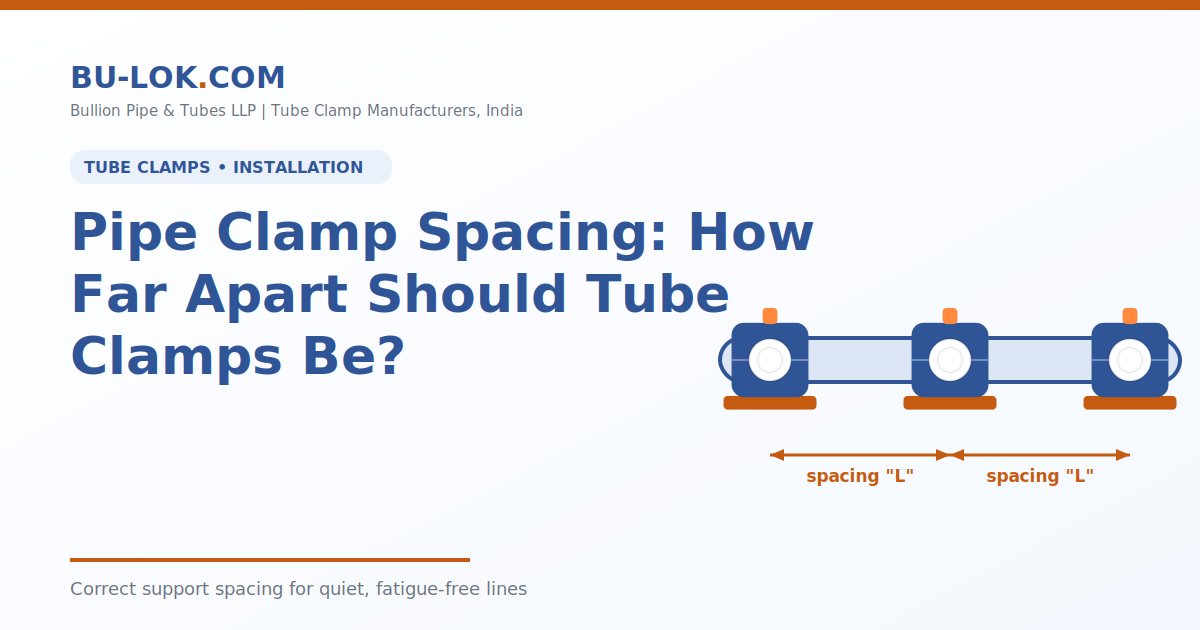
Ask any experienced pipefitter what separates a clean, long-lasting hydraulic installation from a noisy, leak-prone one, and the answer almost always comes back to the same detail: clamp spacing.
Two piping runs can use the identical tube, the identical fluid and the identical pressure, yet one stays silent for a decade while the other rattles, sags and cracks at its fittings within months.
The difference is how far apart the clamps sit. Getting that distance right is one of the cheapest and most powerful reliability decisions you can make on a project.
Why Clamp Spacing Matters More Than People Think?
A tube carrying pressurized fluid is never truly still. Every pump stroke, valve closure and pressure surge sends a pulse down the line, and the unsupported length between two clamps behaves like a guitar string – the longer the span, the more it flexes and the lower its natural frequency.
When that frequency lines up with the pulsing of the system, the pipe resonates. Resonance is where the real damage starts: work-hardening of the tube wall, loosening of threaded fittings, fatigue cracks at weld joints, and slow leaks that are expensive to trace.
Space your clamps too far apart and the pipe droops under its own weight and the weight of the fluid inside it. That sag concentrates bending stress at the nearest fitting. Space them correctly and the same run stays rigid, quiet and stress-free.
Clamp spacing, in other words, is not a finishing touch – it is a structural design parameter.
A Practical Tube Clamp Spacing Guide
There is no single universal number, because the correct spacing depends on tube outer diameter, wall thickness, the fluid being carried and whether the run is horizontal or vertical.
That said, the industry works from well-established rules of thumb. As a starting point for rigid steel hydraulic tubing:
| Tube Outer Diameter | Typical Maximum Clamp Spacing |
| Up to 12 mm (½”) | Around 1.5 m (roughly 5 ft) |
| 13–25 mm (½”–1″) | Around 2 m (roughly 6–7 ft) |
| 26–50 mm (1″–2″) | Around 2.5 m (roughly 8 ft) |
| Above 50 mm (2″+) | 3 m or less, confirmed by load calc |
Treat these as ceilings, not targets. Larger, heavier and higher-pressure lines should be clamped closer together, not further apart.
Plastic and thin-wall tubing sags far more readily than thick-wall steel, so it needs tighter spacing again. When in doubt, add a clamp – supports are inexpensive compared to a failed line.
Don’t Forget Bends, Valves and Vertical Runs
Straight-run spacing is only half the story. The points where piping changes direction or carries a concentrated load are exactly where failures cluster, so they need extra attention:
- Clamp on both sides of every bend, as close to the bend radius as practical, so internal shock cannot whip the elbow.
- Add a support within a short distance of every tee, reducer, flexible connector and equipment nozzle.
- Place a clamp near heavy in-line components such as valves and filters, so their weight is not hanging off a fitting.
- On vertical risers, support the weight at regular intervals – commonly every floor level or every 2.5–3.5 m – and use a proper load-bearing clamp, not just a locating one.
Common Spacing Mistakes to Avoid
The most frequent error is achieving “perfect” spacing on a long straight run while completely ignoring the fittings, so the pipe is beautifully supported everywhere except the places that actually fail.
The second is stretching spacing when materials run short on site – a false economy that guarantees rework.
The third is over-tightening the clamp bolt in the belief that tighter is safer; a clamp only needs to grip the tube evenly around its full circumference, and crushing the body helps no one.
Get the Spacing Right the First Time
Correct clamp spacing keeps a line quiet, keeps it in position and keeps it off its fittings – the three things that decide whether a piping system lasts. Bullion Pipe & Tubes LLP manufactures the full DIN 3015 range of light duty tube clamps, heavy duty tube clamps and twin series tube clamps, and our engineering team can help you cross-check spacing, sizing and mounting for your exact tube diameter and pressure.
If you would like a spacing recommendation for your project, reach out and contact us for a quote and we will help you specify it correctly from the start.