
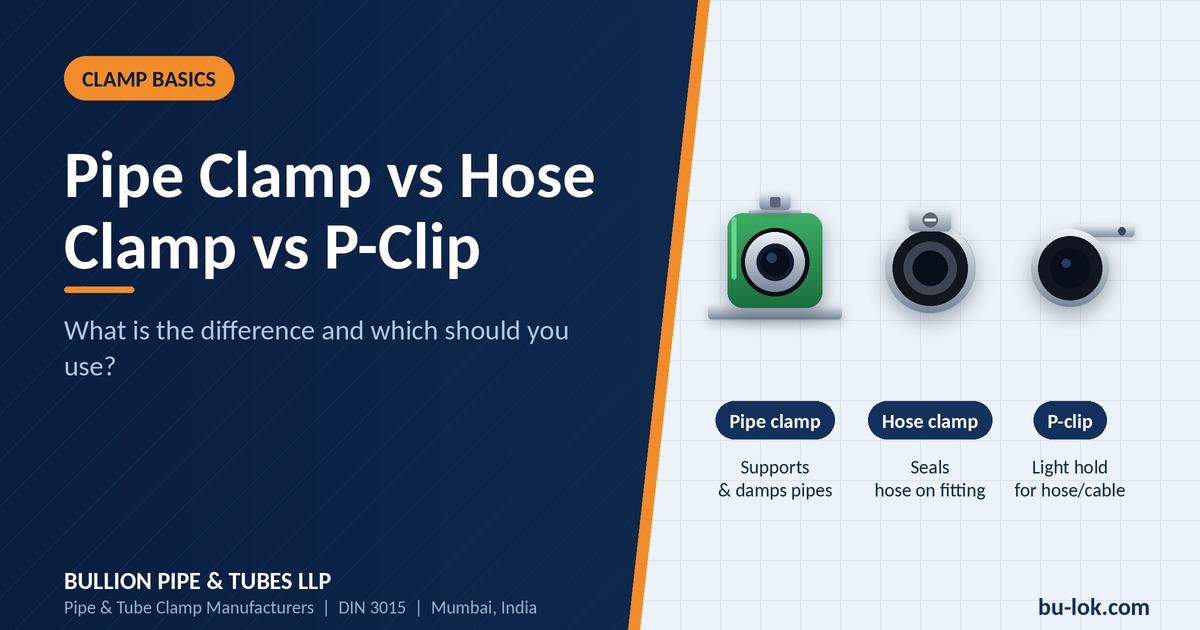
A pipe clamp supports and damps a rigid pipe or tube. A hose clamp seals a hose onto a fitting. A P-clip, also called a cushion clamp, lightly holds hoses, cables and thin-wall tubes. They look alike but do different jobs, and using the wrong one is a common cause of leaks, rubbing and fatigue cracks.
What Is a Pipe Clamp?
A pipe clamp, also called a tube clamp or hydraulic pipe clamp, fastens, routes and supports pipes, tubes and hoses along a wall, frame, skid or machine. A standard DIN 3015 pipe clamp has:
- Two clamping jaws (clamp halves) that close around the pipe
- A weld plate or mounting plate that fixes the assembly to the structure
- A cover plate and a hex bolt that tighten the jaws evenly around the pipe
Its real job is damping. In hydraulic and pneumatic systems, pressurised fluid makes pipes pulse, shake and resonate. A well-engineered clamp absorbs that vibration, reduces noise, stops rubbing and prevents fatigue cracking at fittings and welds.
What Is a Hose Clamp?
A hose clamp, such as a worm-drive or band clamp, squeezes a flexible hose onto a barb, spigot or fitting to prevent leaks or pull-off. It is a sealing and retention device. It is not designed to support a pipe run or damp vibration.
What Is a P-Clip or Cushion Clamp?
A P-clip or cushion clamp is a rubber-lined clamp for hoses, cables and thin-wall tubes. It gives light, cushioned support but cannot handle the loads that a rigid, high-pressure line produces.
Pipe Clamp vs Hose Clamp vs P-Clip
| Factor | Pipe / tube clamp | Hose clamp | P-clip / cushion clamp |
| Main job | Support and damp rigid lines | Seal a hose onto a fitting | Lightly hold hoses and cables |
| Vibration damping | Yes, a core function | No | Limited |
| High-pressure lines | Yes (DIN 3015 heavy series) | Not a support device | No |
| Standard | DIN 3015 | Varies | Varies |
| Typical use | Hydraulic, lube, instrumentation | Fluid hose connections | Wiring, light hose routing |
Which One Do You Need?
- Rigid steel or stainless tubing on a machine, skid or wall:use a DIN 3015 pipe clamp.
- A flexible hose slipping off a fitting:use a hose clamp, not a pipe clamp.
- A cable bundle or thin hose with little vibration:a P-clip or cushion clamp is enough.
- Lines that pulse, shock or run at high pressure:use pipe clamps, with the heavy series where pressure or tube size demands it.
Common Mistakes
- Using a hose clamp to support a pipe.It does not damp vibration, so the pipe works loose and fatigues at the fitting.
- Using P-clips on high-pressure hydraulic lines.They cannot absorb pressure surge.
- Choosing a clamp sized to the bore.Pipe clamps are sized to the tube’s outer diameter. Even a slightly oversized clamp lets the pipe vibrate.
Choosing the Right Pipe Clamp
Match five factors:
- Tube outer diameter in mm or inches
- Working pressure and vibration level (light series or heavy series)
- Environment (plastic, aluminum or stainless components)
- Layout (single, twin or stacked)
- Mounting method (weld plate, bolt-on or rail)
Bullion Pipe & Tubes LLP manufactures the full DIN 3015 range: hydraulic pipe clamps, light duty tube clamps for general lines up to 76.1 mm OD, and heavy duty tube clamps up to 219 mm OD. We also supply cushion clamps and P-clips for hoses, cables and thin-wall tubes.
Frequently Asked Questions
Is a pipe clamp the same as a hose clamp?
No. A pipe clamp supports and damps a rigid line. A hose clamp seals a flexible hose onto a fitting.
Can I use a hose clamp to hold a hydraulic pipe?
No. Hose clamps do not damp vibration or absorb pressure shock, so the pipe can fatigue and crack.
What is a P-clip used for?
A P-clip, or cushion clamp, is a rubber-lined clamp for hoses, cables and thin-wall tubes under light load.
What does DIN 3015 mean for pipe clamps?
DIN 3015 is the standard that defines pipe and tube support clamp dimensions and performance. Part 1 is the light series, Part 2 the heavy series and Part 3 the twin series.
Not sure which clamp your line needs? Share your tube OD and pressure with our engineers and get a recommendation and quote.